Last updated October 9, 2026






Free written scope consultation - allowances, timeline, and change-order rules on paper before a single trade is scheduled
How to Hire a Construction Contractor in Los Angeles: A Step-by-Step Guide
In 2023, the California Contractors State License Board received over 20,000 complaints statewide, and the most common trigger wasn’t an unlicensed operator. It was a contractor who held a valid license but put unlicensed subcontractors on the actual job. That’s the gap most hiring guides miss, and it’s exactly the gap this guide-and our more guides & resources-close. If you’re planning a kitchen remodel, bathroom renovation, or whole-home project in Los Angeles, you’ll learn a vetting process that goes three steps deeper than the standard “get three bids and check Yelp” advice, so the person you hire is the person who actually does the work.
Styles & brands we work with





Quick Answer
The right way to hire a construction contractor in Los Angeles is to verify the general contractor’s license with the CSLB, confirm every subcontractor’s license independently, require a written scope of work with material specifications before signing, check that crew members are employees or verified professionals rather than day laborers, and cap your down payment at the legal limit. In Los Angeles specifically, where contractor fraud complaints run among the highest in California, this deeper vetting process matters even more than price comparison.
Table of Contents
- Step 1: Verify the License – and the Subcontractors Behind It
- Step 2: Demand a Written Scope of Work Before You Sign Anything
- Step 3: Ask Exactly Who Shows Up – and How They’re Verified
- Step 4: Read the Contract for Red Flags That Shift Risk to You
- Step 5: Structure a Payment Schedule That Protects Both Sides
- Step 6: Check Los Angeles Specific Requirements and Local Context
- Common Mistakes to Avoid
- When to Call a Professional
- Frequently Asked Questions
- The Bottom Line
This guide is written from our perspective as a general contractor in Los Angeles. We’ve been doing this since 2004 through Mason Remodeling home, and we’ve seen every complication a remodeling project can throw at a homeowner. The process below reflects what we’d tell a friend before they signed anything, not what looks good in a marketing brochure.
Step 1: Verify the License – and the Subcontractors Behind It
Every hiring guide tells you to check the contractor’s license with the California Contractors State License Board. That’s table stakes. What almost no guide tells you is to verify the subcontractors too. Here’s why it matters for your liability: when an unlicensed subcontractor gets injured on your property, or damages your home, the general contractor’s insurance may not cover the claim because the subcontractor wasn’t legally permitted to perform the work. You can end up holding the bag.
In Los Angeles, the practice of “license borrowing” is common enough that the CSLB flags it in its own consumer alerts. A general contractor lists a valid license number on the bid, but the crew that shows up works under someone else’s license or no license at all. The fix is simple: ask for the license number of every subcontractor who will step foot on your property before work starts.
Here’s the verification process we recommend, step by step:
- Check the GC’s license at cslb.ca.gov. Confirm the license is active, the name on the license matches the name on your contract, and the classification matches the work (a “B” General Building license covers most remodels; a “C” specialty license only covers that trade).
- Ask for a written subcontractor list for your project, including license numbers for plumbing, electrical, HVAC, and any other trade that will be on site.
- Verify each subcontractor’s license independently on the CSLB website. Don’t accept the GC’s word for it. The CSLB database is free and takes two minutes per name.
- Confirm workers’ compensation coverage for anyone who will be on your property. A legitimate Los Angeles contractor carries workers’ comp and can show you the certificate. If the GC says they “don’t need it” because the crew are independent contractors, that’s a red flag.
- Ask about the permitting plan. In Los Angeles, most remodeling work that involves structural, electrical, plumbing, or mechanical changes requires a permit from the Los Angeles Department of Building and Safety (LADBS). The contractor should name the specific permits they’ll pull, not just say “we handle permits.”
In our experience, the homeowners who get hurt aren’t the ones who skipped checking entirely. They’re the ones who checked the GC’s license, saw it was valid, and stopped there. The risk lives one layer down. If a contractor hesitates to provide subcontractor license numbers, walk away. There are too many good, transparent operations in this city to settle for one that hides information.
Step 2: Demand a Written Scope of Work Before You Sign Anything
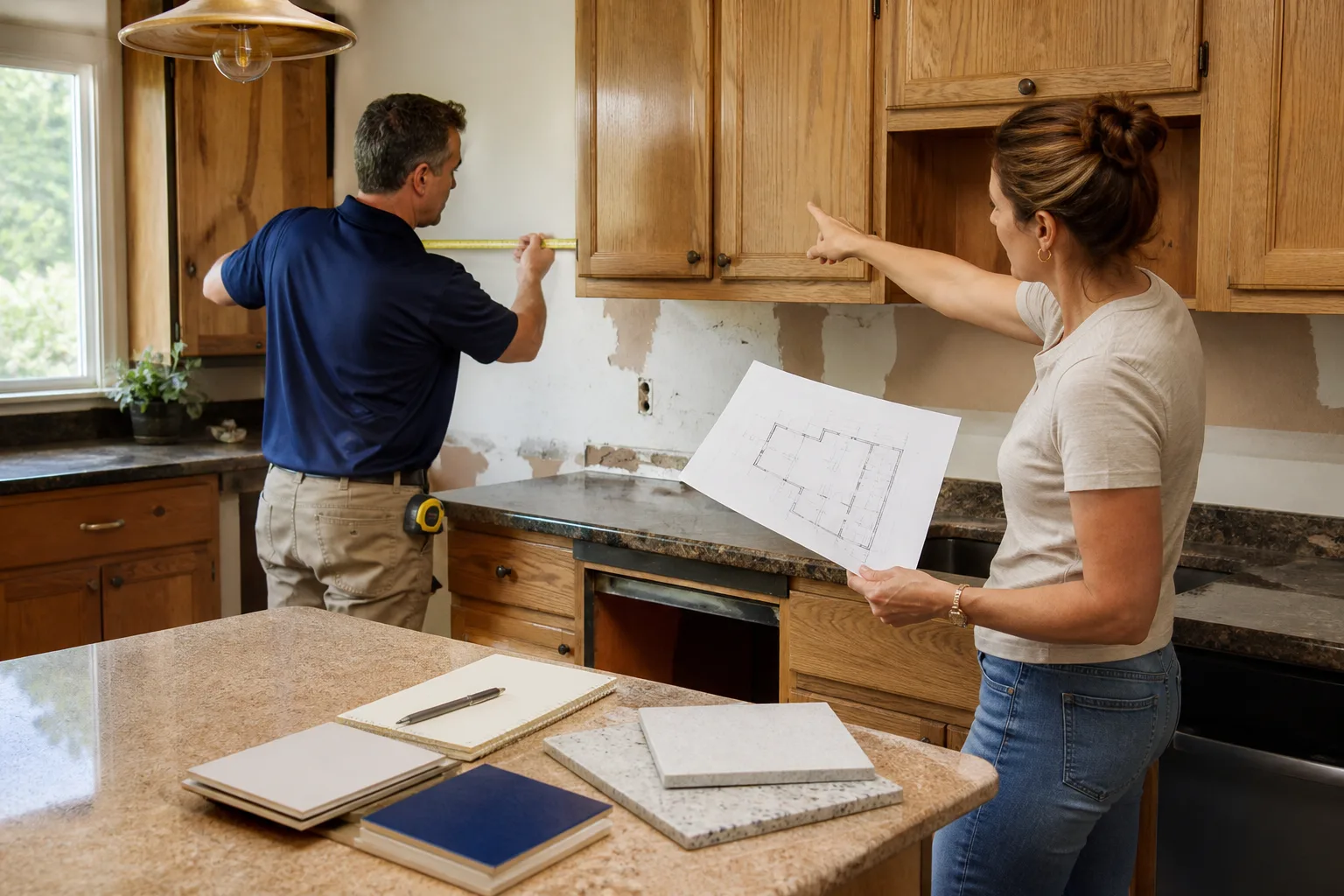
A written price is not the same as a written scope of work. The price tells you what you’ll pay. The scope tells you what you’ll actually get for that money, and without it, you have no way to hold the contractor accountable when the finished product doesn’t match what you pictured. In Los Angeles, where home values are high and renovation disputes are common, a vague scope is the single biggest source of conflict we see on home remodeling in Los Angeles projects.
Material specifications are not optional. A line item that says “kitchen faucet – $300” tells you nothing. You need to know the make and model. “Kohler Sous Pro-Style faucet in polished nickel” is a specification. “Mid-range faucet” is a blank check. The same goes for cabinetry (KraftMaid, Wellborn), stone surfaces (Cambria, Silestone, Caesarstone), and tile. If the contractor won’t specify brands and model numbers in writing, they’re keeping the door open to substitute cheaper materials at the same price.
Understand what “allowances” actually mean. An allowance is a placeholder dollar amount for materials that haven’t been selected yet. Here’s the catch: if the allowance is $500 for a bathroom vanity and you pick one that costs $900, you pay the difference. For a full breakdown of what to watch for after your project wraps up, see our Bathroom Remodeling Maintenance Schedule: What to Do and When. If you pick one that costs $300, some contractors keep the $200 as profit. Before you sign, ask two questions about every allowance in the bid: “What happens if I go under?” and “What happens if I go over?” Get the answer in writing.
A complete scope of work in Los Angeles should include:
- All material specifications by brand, model, and finish
- The exact square footage or linear footage being built or replaced
- Who is responsible for demolition and debris removal
- Which permits will be pulled and who pays the permit fees
- The order of operations and approximate timeline (not a fixed date, but a sequence)
- What “substantial completion” means and when final payment is due
- A change-order process in writing: how changes are priced, approved, and documented
If the scope is one page long and you’re doing a $60,000 kitchen remodel, that’s not a concise contractor. That’s a problem waiting to happen. A real scope for a project that size runs multiple pages, because it anticipates the details that go wrong. It’s the difference between a contractor who has done this before and one who is figuring it out on your dime.
Step 3: Ask Exactly Who Shows Up – and How They’re Verified
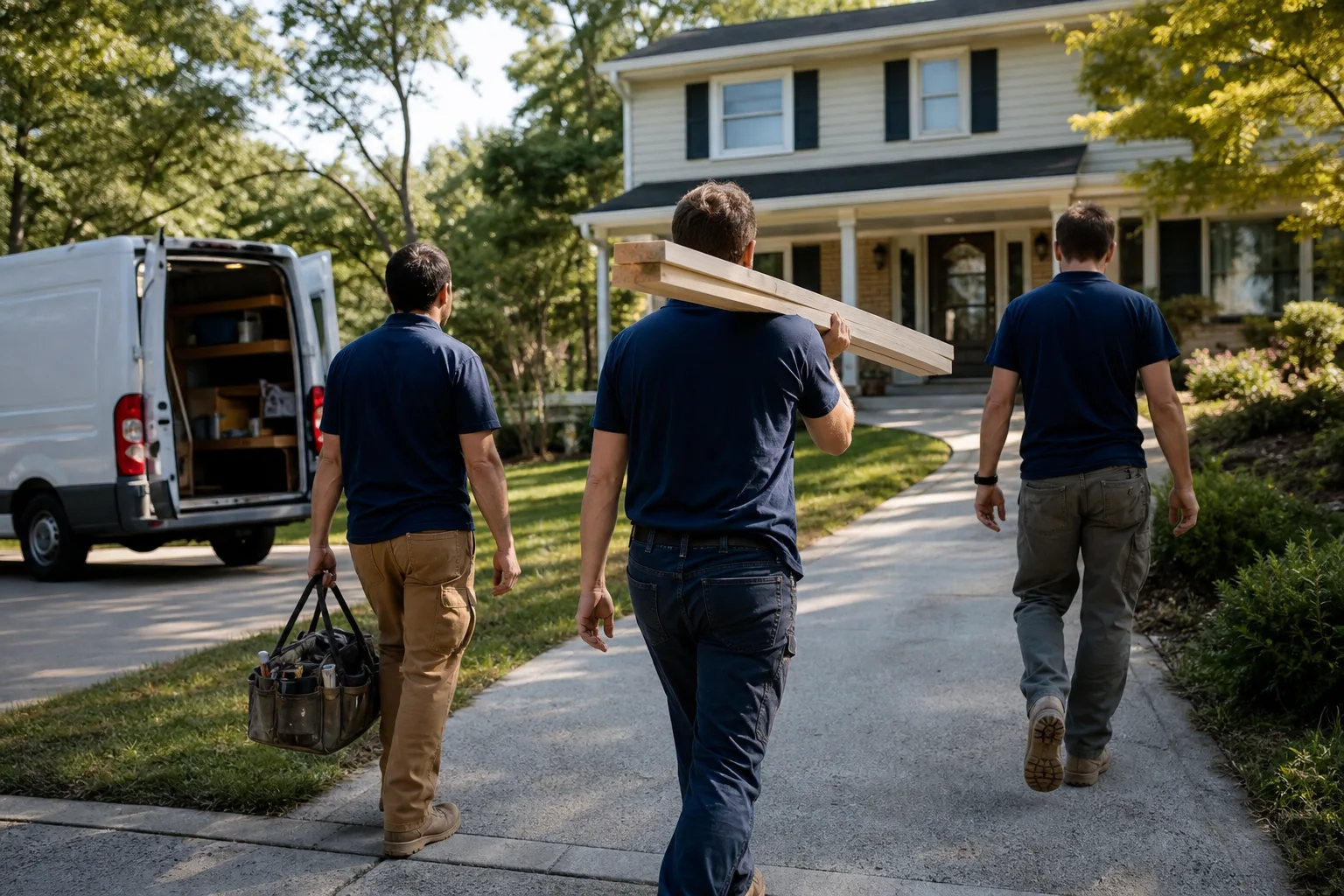
The person who sells you the job is rarely the person who builds it. In Los Angeles, where the remodeler you hire may subcontract to crews assembled from day-labor lines or temporary staffing, knowing who physically walks through your door is a genuine safety decision. This is especially true for homeowners who are often home alone, parents with young children, or older adults who treat opening the door to a stranger as more than a formality.
Here are the questions to ask before you sign, not after the crew arrives:
- Are the people on the job site your employees, verified subcontractors, or day laborers? Employees and established subcontractors carry accountability. Day laborers carry none. If the answer involves “it depends on the day,” that’s your answer.
- Will I receive the names of every crew member before they arrive? A contractor who can’t tell you who’s coming tomorrow can’t tell you who was in your house yesterday if something goes missing.
- Are crew members background-checked? In a city the size of Los Angeles, background checks should be standard, not premium. A contractor who doesn’t screen workers is transferring that risk to you.
- Will each crew member present a photo ID badge at the door? This is a simple, verifiable policy that separates professional operations from casual ones.
- Does your crew wear a marked uniform? Uniforms aren’t just about branding. They tell you that the person in your hallway is supposed to be there.
We built our entire business around answering these questions, because we know what happens when contractors don’t. Through our Threshold Verified standards, every crew member is background-checked and identity-verified. You get the technician’s name and photo before the visit, and they show a photo ID badge at your door before they step inside. This isn’t a premium feature we charge extra for. It’s how every general contractor in Los Angeles should operate, and most don’t.
If a contractor gets defensive when you ask who’s coming, that’s not about trust. That’s about information. You wouldn’t let a stranger into your home without knowing their name in any other context. Construction should not be the exception.
Step 4: Read the Contract for Red Flags That Shift Risk to You
Contract language is where honest contractors protect themselves and dishonest ones ambush you. In Los Angeles, where home improvement contracts fall under specific California law, there are certain clauses that should stop you cold. Here are the red flags we tell homeowners to watch for, and why each one matters.
Vague change-order clauses. A change order is how your final cost grows. On nearly every remodel, some change is legitimate: you decide to upgrade the tile, the framing reveals an unexpected issue, you want an extra outlet. The problem is a clause that says “changes will be billed at the contractor’s standard rates” without defining what those rates are. You deserve to see the rates, in writing, before you sign. A good contract defines in advance how changes are priced: labor rate per hour, markup percentage on materials, and who approves the change before work proceeds.
No lien waiver provisions. In California, if your contractor doesn’t pay a subcontractor, that subcontractor can place a mechanic’s lien on your property, even if you already paid the contractor in full. A lien waiver is a document signed by each subcontractor that says they’ve been paid and they waive their right to lien your home for that payment. Your contract should require the contractor to provide lien waivers from every subcontractor at every payment milestone. If the contract doesn’t mention lien waivers at all, you’re the one who’s exposed.
Front-loaded payment schedules. We’ll cover payment structure in step 5, but the red flag to look for here is a schedule where the contractor collects 50% or more before any work begins, or where the early payments outweigh the work completed. A payment schedule should track progress: you pay for work as it’s done, not for work the contractor promises to do someday.
Arbitration clauses that lock you out of court. Binding arbitration isn’t automatically bad, but in many home improvement contracts, it’s the contractor choosing a venue where they’re repeat customers and you’re not. Read carefully. In California, you may have the right to reject arbitration provisions within a specified window, but the window closes fast.
“Homeowner responsible for” catch-alls. Watch for clauses that assign you responsibility for things that are the contractor’s job: jobsite cleanup, debris removal, permit compliance, or material defects. If a clause makes you responsible for something you thought you were hiring the contractor to handle, that’s risk being shifted onto you. Ask for it to be struck or clarified.
A good Los Angeles contract is boring to read. It’s specific, it’s clear, and it has no surprises in the fine print because there are no surprises. If you read a clause twice and still don’t understand what it means, ask. If the contractor can’t explain it in plain language, that’s not a communication problem. That’s a warning.
Step 5: Structure a Payment Schedule That Protects Both Sides
California law sets specific limits on down payments for home improvement contracts, and most Los Angeles homeowners don’t know it. Under California Business and Professions Code section 7159, a contractor cannot collect more than 10% of the total project cost or $1,000, whichever is less, as a down payment before work begins. That’s the legal ceiling. If a contractor asks for 30% or 50% up front, they’re either breaking the law or they’ve structured the contract as something other than a home improvement contract to get around it. Either way, you should walk.
Here’s how to structure a payment schedule that’s fair to both parties:
- Deposit: 10% or $1,000, whichever is less. This is the legal maximum in California for home improvement projects. Any contractor asking for more before work begins is running afoul of the law. It’s enough to show you’re committed. It’s not enough that the contractor can disappear with your money and still come out ahead.
- Progress payments tied to milestones, not dates. A milestone is “drywall is hung and taped.” A date is “two weeks after work begins.” Never pay by the calendar. Pay by the work. The schedule should list specific, verifiable milestones, and you should inspect the work before writing each check.
- Hold back 10-15% until final inspection passes. The final payment is your only leverage at the end of the job. Don’t release it until the work is complete, the LADBS inspection has passed (if a permit was pulled), the final walk-through is done, and you have lien waivers from every subcontractor.
- Get every payment acknowledged in writing. A receipt, an invoice marked paid, an email confirmation. In Los Angeles, payment disputes are common enough that you want a paper trail for every dollar.
- Never pay in cash without a receipt. Cash payments with no paper trail are how payment disputes become unresolvable. If a contractor asks for cash, ask for a written receipt at the moment of payment.
Some contractors will tell you they need a bigger deposit to “lock in materials” or “secure the crew.” That’s their cash-flow problem, not yours. A well-run operation has the working capital to buy materials at the start of a job without using your money as their line of credit. The contractors who pressure you for large up-front payments are often the ones who are behind on other jobs and using your deposit to float them. That’s not a contractor you want on your home.
Step 6: Check Los Angeles Specific Requirements and Local Context
Hiring a contractor in Los Angeles is not the same as hiring one in Phoenix or Dallas. The city has its own building code, its own permitting culture, and its own seismic and climate realities. Our Seasonal Construction Care for Los Angeles: Year-Round Homeowner’s Guide covers how these factors shift through the year. Here’s what you need to know specific to doing construction work in this city.
LADBS permits are mandatory for most remodeling work. The Los Angeles Department of Building and Safety requires permits for any project that changes the structure, electrical, plumbing, or mechanical systems of your home. That includes kitchen remodels that move plumbing lines, bathroom remodels that change the floor structure, and any whole-home renovation. An experienced Los Angeles contractor handles permits as part of the job, pulls them before work starts, and schedules inspections as stages complete. A contractor who tells you “we don’t need a permit for this” on a job that clearly needs one is not doing you a favor. They’re putting your home’s value and your liability at risk. If problems do surface later, our Bathroom Remodeling Troubleshooting: Common Problems and How to Fix Them can help you sort symptoms from causes.
Soft-story and hillside considerations. Many homes in Los Angeles are built on hillsides or in neighborhoods with soft-story construction (a garage or open space on the ground floor under living space). These homes have specific seismic retrofitting requirements that affect remodeling work. If your home is in one of these categories, the contractor should be able to speak to the additional engineering and permitting work that may be required before you start tearing down walls.
Drought and drainage realities. Los Angeles building code treats water drainage differently than many other cities because of the drought-fire-flood cycle. Exterior work, from hardscaping to roofing, has to account for water management. A contractor who has worked in this city for years knows that you don’t just pour a concrete pad and call it done. You plan for drainage, you use the right base materials for our soil, and you build for fire resilience where the location calls for it. Where your hardscape needs a solid base, products like those from Sakrete or Quikrete are what we specify for Los Angeles conditions, not the cheapest bag mix from the big-box store.
Los Angeles market pricing. Remodeling costs in Los Angeles run higher than the national average, and they vary by neighborhood. A mid-range kitchen remodel in Los Angeles typically runs $40,000 to $80,000, while a full-gut kitchen in a high-end neighborhood like Beverly Hills or Brentwood can run $120,000 and up. A bathroom remodel in Los Angeles usually lands between $20,000 and $50,000 depending on finishes and whether you’re moving plumbing. Whole-home remodels in this market commonly start around $150,000 and run well past $300,000 for a full renovation. These are working numbers, not quotes, but they’ll help you spot a bid that’s either too cheap to be real or too expensive to be fair.
One more Los Angeles specific: parking and access. Crews need somewhere to park, and in neighborhoods like Silver Lake or Koreatown, that’s genuinely hard. A good contractor thinks about logistics before the job starts, not on day one when the crew is circling the block. It’s a small thing, but it tells you whether you’re dealing with someone who has actually managed projects in this city.
Common Mistakes to Avoid
- Checking only the GC’s license and stopping there. The CSLB data shows that unlicensed subcontractors are the most common source of complaints. Verify every license on the job, not just the one on the contract.
- Comparing bids on price alone, without comparing scopes. In Los Angeles, two bids that are $20,000 apart often aren’t bidding the same work. The cheap one has a thinner scope. Compare line items, not just bottom lines.
- Paying too much up front. California law caps down payments at 10% or $1,000 for home improvement contracts. Anything more than that is illegal, and any contractor who asks for it is telling you who they are.
- Signing a contract without material specifications. “Tile,” “faucet,” and “vanity” are not specifications. Brand names and model numbers are. Without them, you’ve agreed to whatever the contractor decides to buy.
- Skipping the lien waiver requirement. If a subcontractor doesn’t get paid, they can lien your property even though you paid the general contractor. Lien waivers at every payment milestone are your protection.
- Not asking who will be on the job site. You deserve to know the names of the people who will be in your home. In a city this size, “the crew” is not an acceptable answer when you’re opening your door.
When to Call a Professional
You should hire a licensed, vetted contractor for any project that involves structural changes, electrical work, plumbing changes, or anything that requires a permit. That covers kitchen remodels, bathroom renovations, and whole-home projects in Los Angeles. You should also call a professional when the work involves load-bearing walls, when the project touches gas lines or electrical panels, or when the scope is large enough that a mistake becomes a five-figure problem instead of a $200 fix. If you’re uncertain whether your project needs a permit, a quick call to LADBS or a contractor who does this work every day will settle it. Mason Remodeling offers free estimates in Los Angeles. Call (803) 680-2547.
Frequently Asked Questions
Go to the California Contractors State License Board website at cslb.ca.gov, enter the contractor’s license number or business name, and confirm that the license is active, the name matches your contract, and the classification covers your project type. The search is free and takes less than five minutes. You should also verify the license numbers of any subcontractors the contractor plans to use, because that’s where unlicensed work most often hides.
Under California law, the maximum down payment for a home improvement contract is 10% of the total project cost or $1,000, whichever is less. Any contractor asking for more than that before work begins is either violating state law or structuring the agreement to evade it. Hold the contractor to the legal limit and tie all subsequent payments to completed work milestones.
A written scope of work should include specific material brands and model numbers, exact square footage or linear footage, a detailed description of the work being done, who handles demolition and debris, which permits will be pulled, and how change orders are priced and approved. For bathroom remodeling in Los Angeles, that means specifying the vanity make and model, the tile brand and size, the faucet brand and finish, and the shower system, not just “full bath remodel.”
If your project changes the structure, electrical, plumbing, or mechanical systems of your home, you almost certainly need a permit from the Los Angeles Department of Building and Safety. Kitchen remodels that move plumbing, bathroom renovations that alter the floor structure, and any whole-home work all require permits. A reputable Los Angeles contractor pulls permits as part of the job and handles the inspection scheduling.
In California, an unpaid subcontractor can place a mechanic’s lien on your property, even if you already paid the general contractor in full. That’s why your contract should require the contractor to provide lien waivers from every subcontractor at every payment milestone. Without lien waivers, you’re liable for the same work twice, and the second payment goes to a court, not a contractor.
Ask for the names of every crew member before they arrive, and require that each person present a photo ID badge at the door before entering. A professional Los Angeles contractor can tell you who is coming tomorrow. If the answer is “we’ll see who’s available,” you haven’t vetted the contractor enough. You’ll be opening your door to strangers with no way to identify them later if something goes wrong.
The Bottom Line
Hiring a construction contractor in Los Angeles comes down to going deeper than the standard advice. Verify the GC’s license and the subcontractors behind it. Demand a written scope with real material specs, not vague line items. Ask who’s coming and how they’re verified. Read the contract for risk-shifting language, and hold the payment schedule to California’s legal down-payment cap. The homeowners who get hurt aren’t the ones who skip vetting entirely. They’re the ones who stop at the surface. Go three layers deeper, and you’ll hire a contractor who treats your home the way you do.
Written by Isaac Pruett, Owner at Mason Remodeling, serving Los Angeles since 2004.
See the difference
 Before
 After
After Before
 After
After Before
 After
After